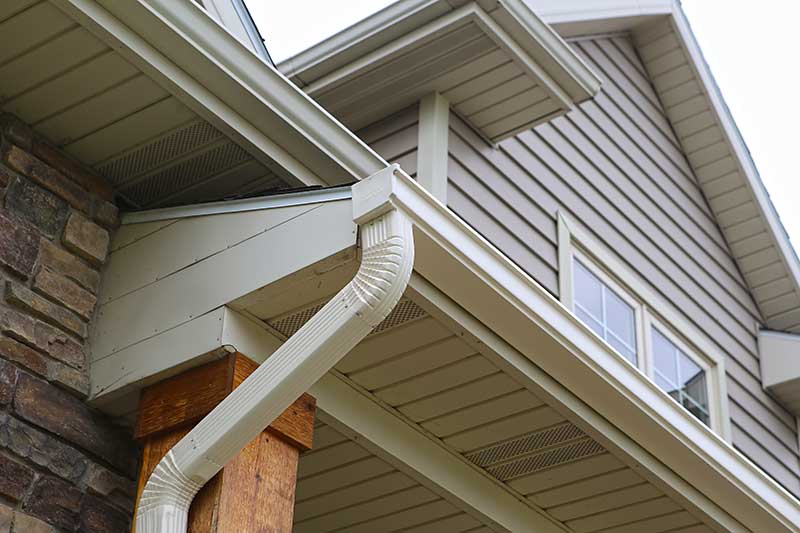
Gutter Covers and What They Actually Solve
A gutter cover keeps leaves, pine needles, seed pods and roof grit out of the trough so water keeps moving. The real benefit is not that you never climb a ladder again. It is that the gutter stops holding a wet organic sludge that stays damp for weeks, feeds mold and mildew along the fascia, and adds dead weight that pulls hangers loose.
Covers matter most on homes with mature maples or pines overhanging the roof, on two and three story homes where ladder work is genuinely risky, and on any run that has already been pulled off the fascia once by a debris and ice load. They matter least on an open lot with no tree canopy.
No cover is maintenance free. Fine debris still collects on top of a screen and has to be brushed off, and the system underneath still needs a look each year. What a good cover does is change an annual clean out into an annual glance, and keep the trough itself empty going into winter.
Ice Dams, Snow Load and the Buffalo Winter
Gutters do not cause ice dams, and no gutter system prevents them. A dam forms when heat escaping into the attic melts snow on the upper roof, the meltwater runs down to the cold overhang and refreezes there. The gutter simply happens to be sitting where the ice ends up, which is why it takes the damage.
The fix is upstream of the gutter. Air sealing the attic floor, adequate insulation, and balanced intake and exhaust ventilation keep the roof deck cold enough that the snow on it does not melt in the first place. Ice and water shield carried up from the eave gives you a membrane under the shingles for the water that does back up.
What the gutter itself has to do is survive the season. That means hangers spaced tightly enough to carry an ice filled trough, heavy gauge aluminum rather than the thinnest stock available, and downspouts that are not the first thing crushed by a sheet of snow sliding off a metal roof above them. If your gutters come loose every February, the problem is usually hanger type and spacing, not the gutter.
Repairing What You Have Versus Replacing the Run
Not every gutter problem is a replacement. A sagging section that is otherwise sound can often be rehung. A leaking corner can be resealed. A clogged underground drain can be cleared without touching the gutter at all. We would rather tell you that than sell you two hundred feet of aluminum you do not need.
Replacement is the honest answer when the failures are spread across the system rather than sitting in one spot:
- Seams separating in more than one or two places along the same run
- Fascia board that is soft or rotted behind the gutter, which has to be rebuilt before anything is rehung
- Gutters that have pulled away from the house repeatedly after being reattached
- Runs that are visibly undersized for the roof above them and overflow in every heavy rain
- Rust perforation on older steel gutter, or cracking and brittleness on vinyl
- A pitch that no longer drains, leaving standing water in the trough between storms
When the fascia is involved, the gutter, the fascia, the soffit and the drip edge all get addressed together. Hanging new gutter on bad wood only moves the failure date.
What a Gutter Installation Day Looks Like
We form the aluminum on site from coil stock, so the run that goes on your house is cut to length that morning rather than joined from ten foot sticks. Old gutter comes down first and the fascia gets inspected while it is exposed, because that is the only time anyone will see it. Damaged board gets replaced before new hangers go in.
New gutter is hung to a deliberate pitch toward each outlet, corners are mitered and sealed, downspouts are strapped to the wall and discharged away from the foundation, and the job site is cleaned and magnet swept before we leave. Most single family homes are finished in one day.